For inventors with an idea and no lawyer
Idea to patent pending

Get your invention across the finish line.

Describe your idea in plain words. We check what already exists, help you file a proper provisional to lock your date, then guide you to the USPTO's own free attorneys to finish the job.

P Novelty check live on real patents
Instant preliminary patent search.
The complete path

Five steps from idea to a real patent

We charge for the guidance and tooling. The hard legal work at the end can be done by a free USPTO Pro Bono attorney — and the provisional you file is what qualifies you for one.

1

Learn

A short course (built on the USPTO's own training) so you understand the system — and earn the certificate that helps you qualify for free help.

2

Check

Search real patents to see what already exists and where your idea is genuinely new.

Free
3

File your provisional

We help you write a clear, examiner-ready provisional and walk you through filing it. Your date is locked; you're "patent pending."

4

Get a free attorney

Your filed provisional qualifies you for the USPTO Pro Bono program. We guide you through applying and matching with a volunteer patent attorney.

Attorney is free
5

Finish the real one

Your Pro Bono attorney drafts the non-provisional. We track your 12-month deadline the whole way so you never miss it.

Free via Pro Bono
The big picture

How the whole patent system actually works

Five stages from idea to an enforceable patent. A provisional is stage 2 — a temporary placeholder, not the finish line.

1. Your ideaNew, useful,not obvious "PATENT PENDING" BEGINS2. ProvisionalTemporary · 12 monthsNot examinedLocks your date WITHIN 12 MONTHS 3. Non-provisionalThe real applicationwith formal claims 4. ExaminationExaminer reviews1–3 years 5. GrantedEnforceablepatent Miss the 12-month deadline at stage 2 and you lose your date. That deadline is the one thing you can't forget — we track it for you.
Step 2

Check your idea against what's already out there

Type your invention. We search the titles of every published US patent and application and show the closest matches — so you understand your novelty before spending a dollar. It's a strong first pass, not a full professional search.

Write like you'd explain it to a friend. More detail = a better check.
The part nobody explains

Provisional to non-provisional: the full 12-month path

Exactly what happens after you file a provisional, when, and what each step costs.

Day 0 — you file the provisional

Your date is locked. You're "patent pending."

The USPTO stamps your filing date. You can now say "patent pending" and pitch, share, or sell with your priority protected. Micro-entity fee: $65. Never examined — it holds your place in line. It also qualifies you for the free Pro Bono program.

Months 0–10 — build, test, decide

Use the year.

  • Refine the invention — anything new can go into the real application later.
  • Test the market and look for buyers or funding while "patent pending."
  • Apply for a free Pro Bono attorney (below) to write the non-provisional.
Months 10–11 — prepare the non-provisional

The real, complete application.

  • Full specification — detailed description of how to make and use it.
  • Formal claims — the legal sentences that define what you own (where an attorney matters most — and Pro Bono covers it).
  • Drawings, abstract, inventor's oath, and a priority claim back to your provisional.
By Month 12 — the hard deadline

File within 12 months — or lose everything.

You must file the non-provisional (or a PCT) within 12 months of the provisional to keep your date. Miss it and you start over. Micro-entity fees run roughly $400–$450 (filing + search + exam). We count down the deadline for you the whole time.

~Month 18 — publication

Your application becomes public.

Around 18 months after your date it publishes for anyone to read (unless you request otherwise). Normal — the public sees it, you get the protection.

Months 12–36 — examination

An examiner reviews it and you respond.

An examiner searches prior art and usually issues an "office action" (rejections). You or your attorney reply with amendments and arguments — often a few rounds over one to three years.

Allowance → grant

Pay the issue fee and get a real patent.

Once allowed, you pay an issue fee (~$160 micro-entity) and it's granted. A utility patent lasts 20 years from the non-provisional filing date, with maintenance fees at 3.5, 7.5, and 11.5 years.

The USPTO gives this away — nobody can find it

Free help you probably didn't know existed

The USPTO runs a huge amount of free assistance. Their site buries it. We put it in one place and guide you through it.

Am I eligible for a free Pro Bono patent attorney?

The USPTO Pro Bono program matches volunteer patent attorneys with inventors under an income limit — usually about 3× the federal poverty level. Quick estimate:

Estimate only, based on 2026 federal poverty guidelines × 3. Regional programs set their own limits — we'll point you to yours.
The key unlock: to qualify for Pro Bono you must show basic patent-system knowledge — by having an application on file (your provisional does this) or completing the USPTO's free certificate course (our course does this). Filing your provisional is the on-ramp to a free attorney.
P
Patent Pro BonoFree volunteer attorneys, by region.
I
Inventors Assistance CenterFree USPTO phone help for pro se filers.
L
Law School ClinicsFree help from supervised law students.
R
Resource Centers (PTRC)Free local, in-person help.
$
Micro-entity status80% off USPTO fees if you qualify.
S
Patent Public SearchFree prior-art search (we do this for you).
Learn it once, keep it forever

The "Patent It Yourself" course

Built on the USPTO's own official training, rewritten so a normal human can follow it. Finishing it also earns the certificate that helps you qualify for free Pro Bono help.

Is your idea patentable?New, useful, and non-obvious — what those actually mean, with examples.
Do your own prior-art searchHow to search real patents and read what you find.
What a provisional is (and isn't)The 12-month clock, "patent pending," and the deadline that matters.
Writing a strong, clear disclosureThe structure examiners expect, consistent terms, and describing your invention so it holds up.
Filing it yourself in Patent CenterPro se filing, micro-entity status, the SB/16 and SB/15A forms.
The non-provisional and your optionsClaims, the deadline, and how to get a free Pro Bono attorney to finish it.
After you file"Patent pending," maintenance fees, and when it's worth getting an attorney.
The app

Five simple steps, right on your iPhone

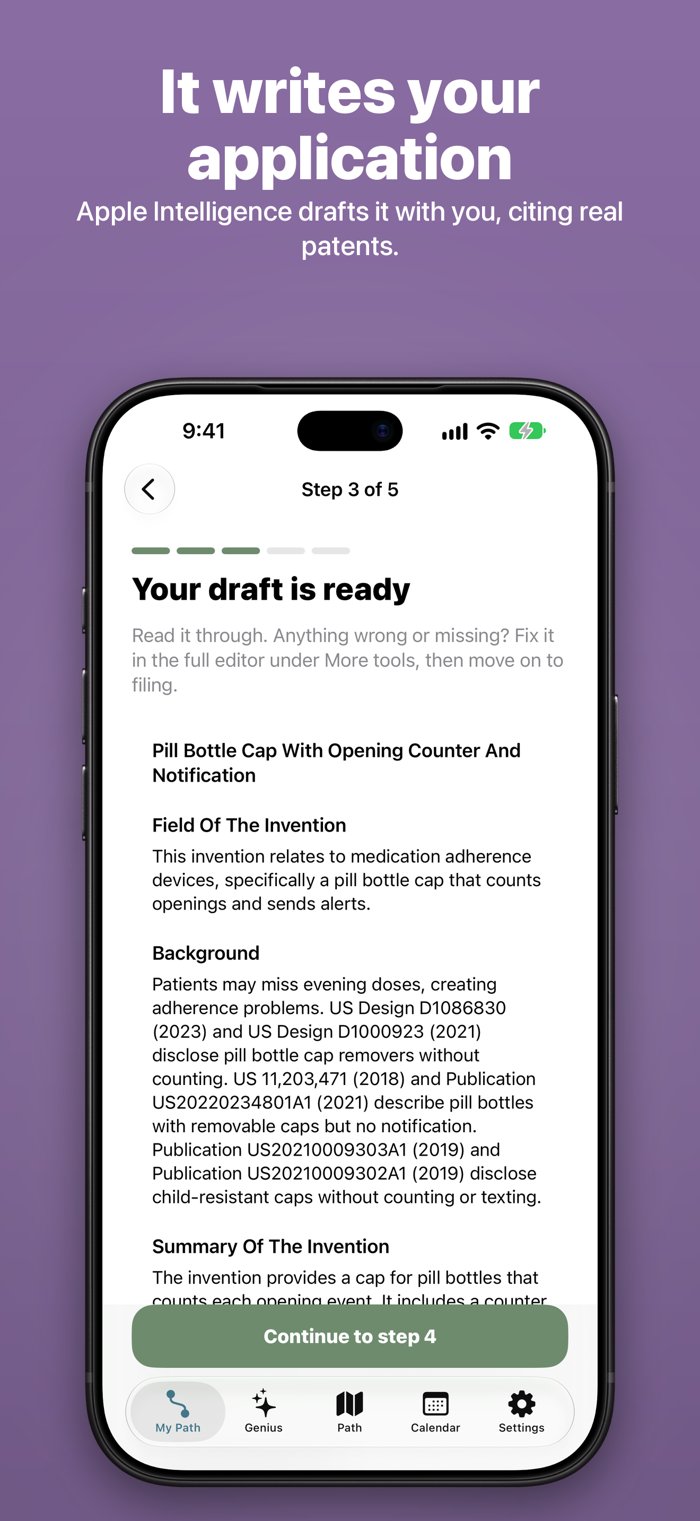
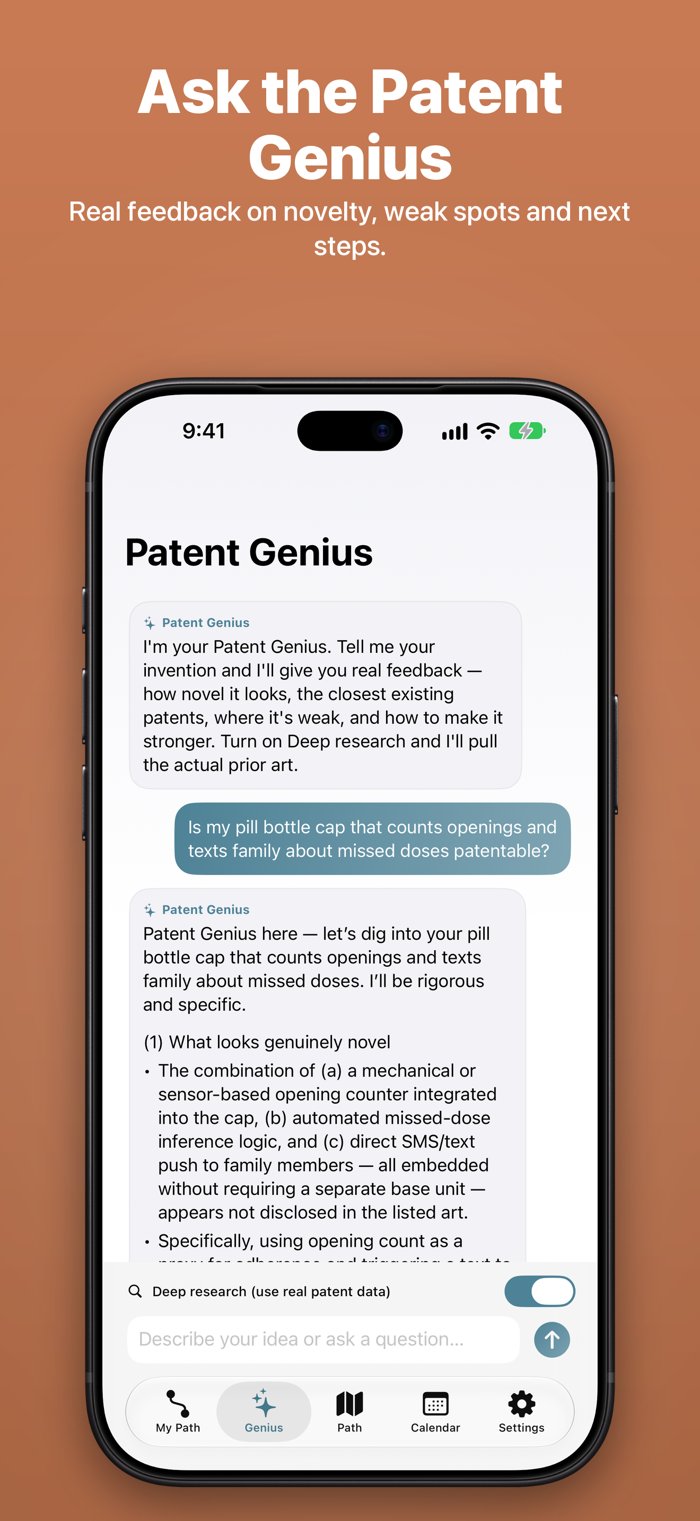
Describe your idea in your own words. Provisional Path searches real patents, explains how yours is different, and writes your application with you using Apple Intelligence. Private, and nothing to install on a computer.
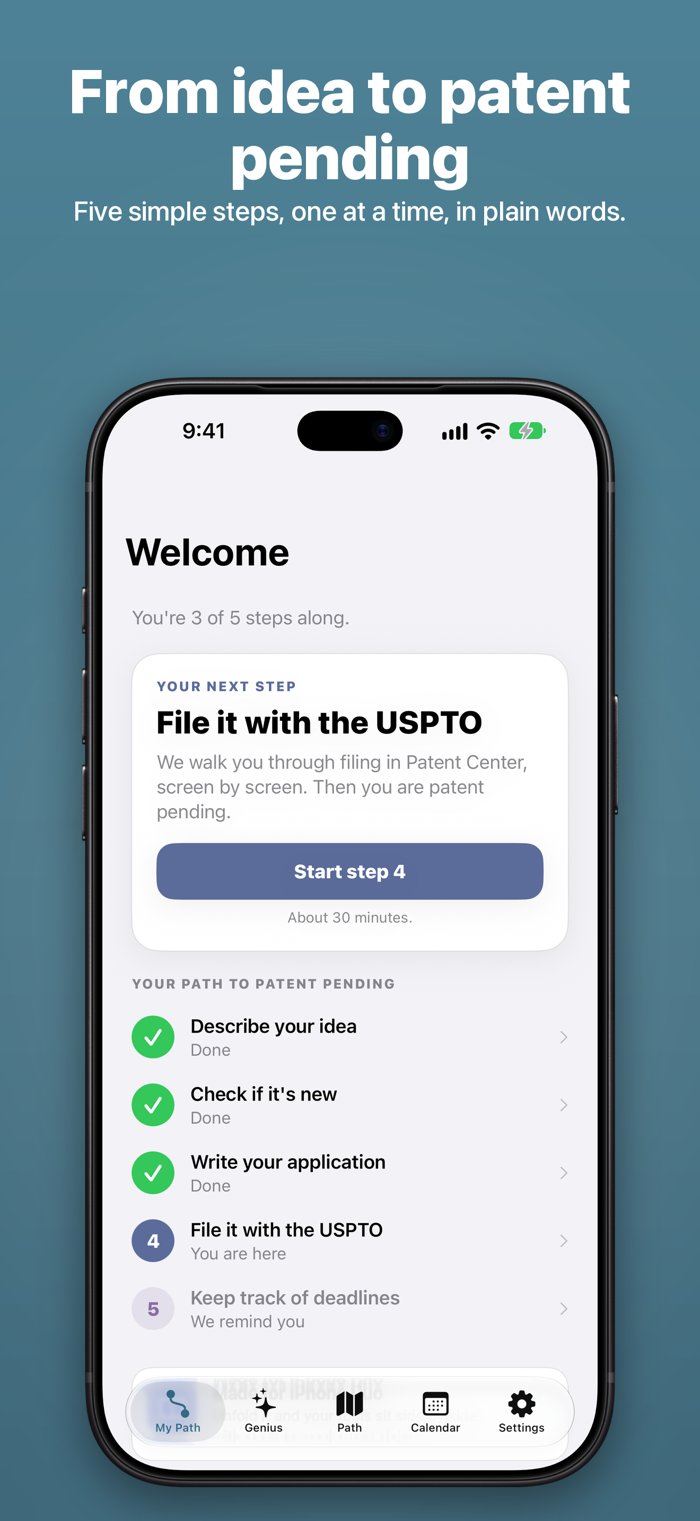
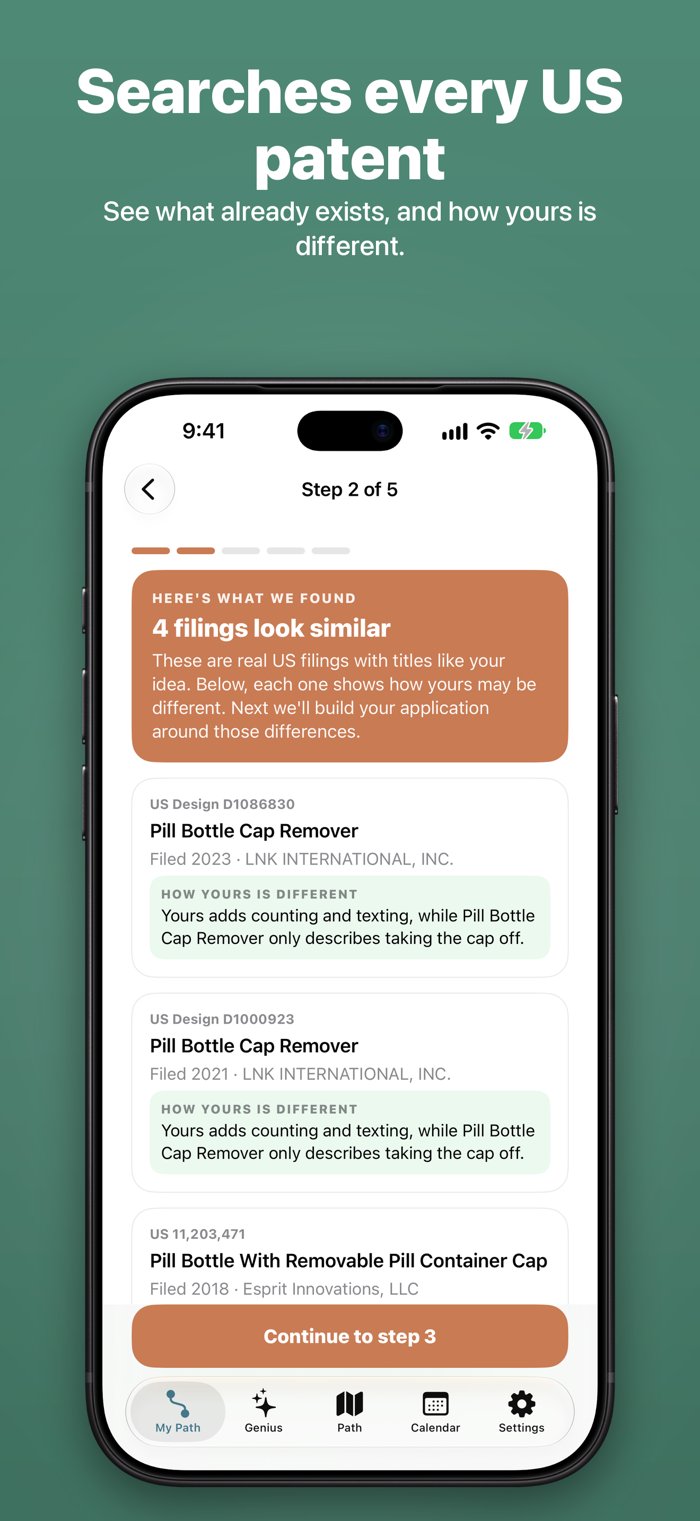
Your path to patent pending, five steps with progress Search results from real US patents, with how your idea is different A drafted provisional application with real patent citations Patent Genius answering a patentability question
Made for iPhone Duo

Unfold it and see your whole path

On iPhone Duo your next step and the five-step path sit side by side, with room to read every claim. Fold it and keep going on the outside screen.
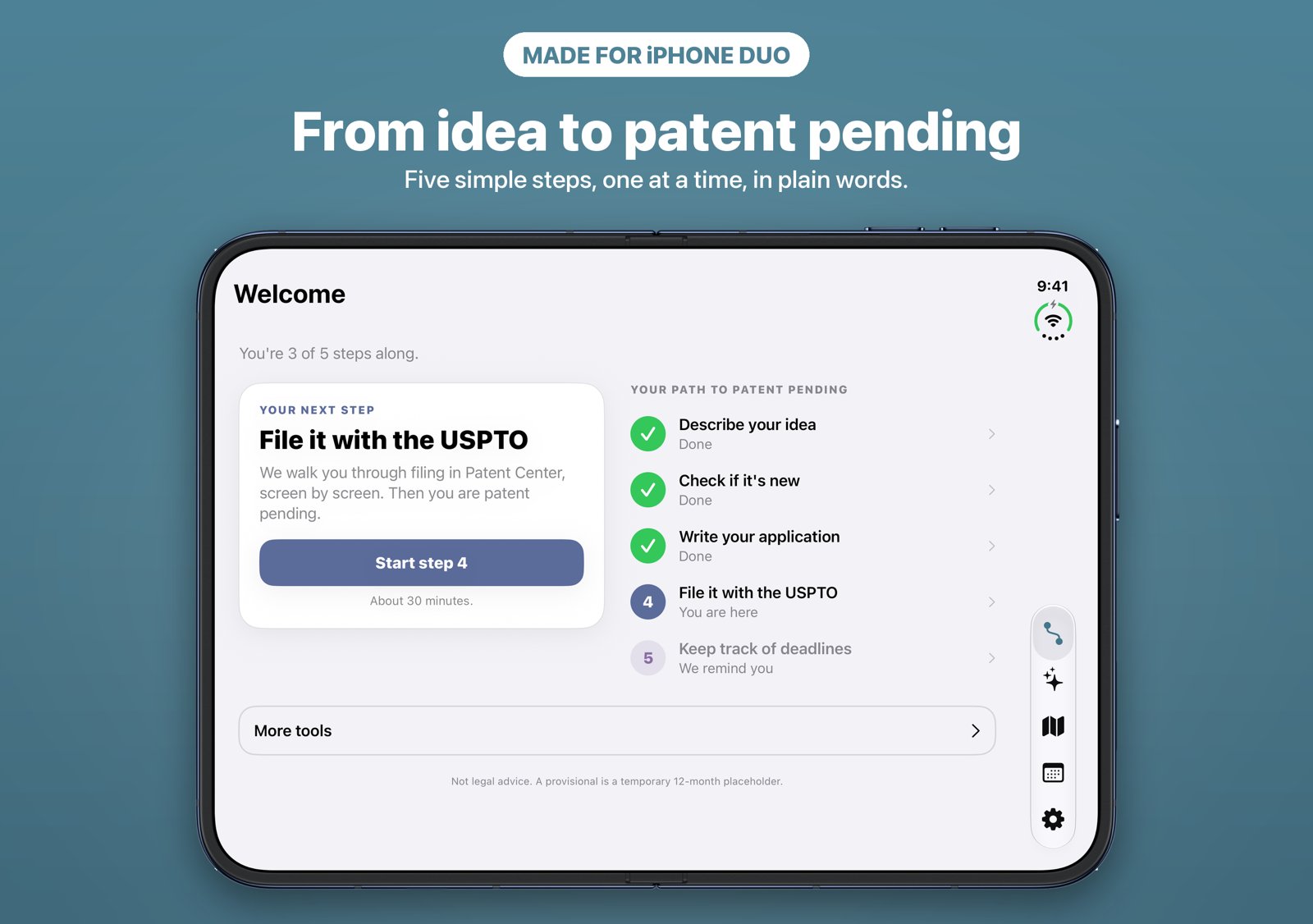
Provisional Path on the unfolded iPhone Duo
Simple, honest pricing

Try everything free for 7 days

Search, write, file and track your provisional and your full application. The attorney at the end can be free through the USPTO Pro Bono program.

Best value

Yearly

$149.99/year

About $2.88 a week. Free for 7 days, then billed yearly.

Monthly

$19.99/month

Free for 7 days, then billed monthly. Cancel anytime.

Weekly

$5.99/week

Free for 7 days, then billed weekly. Cancel anytime.

USPTO filing fees are separate and paid by you (a provisional is $65 at micro-entity rates).

The disclaimers that protect you. Provisional Path is a self-help tool — not a law firm and not legal advice. A provisional application is a temporary 12-month placeholder that is never examined and grants no enforceable rights on its own. You must file a non-provisional within 12 months or lose your priority date. Your protection depends on what you disclose. Government fees are your responsibility and you sign and submit your own application. Eligibility for Pro Bono, micro-entity status, and other programs is determined by the USPTO and its regional partners, not by us. Not affiliated with the U.S. Patent and Trademark Office.